AI Strategy Before AI Tools.
The Order Matters
Two Ways to Approach AI. Only One of Them Works.
Typical Organization
“Let’s experiment with AI tools.”
Shiny object syndrome. Whatever launched this week.
Tool fatigue and isolated, disconnected experiments.
The FAIM Approach
“Where can AI improve our operations?”
Process-driven strategy. Operations first, software last.
Measurable impact and tightly integrated workflows.
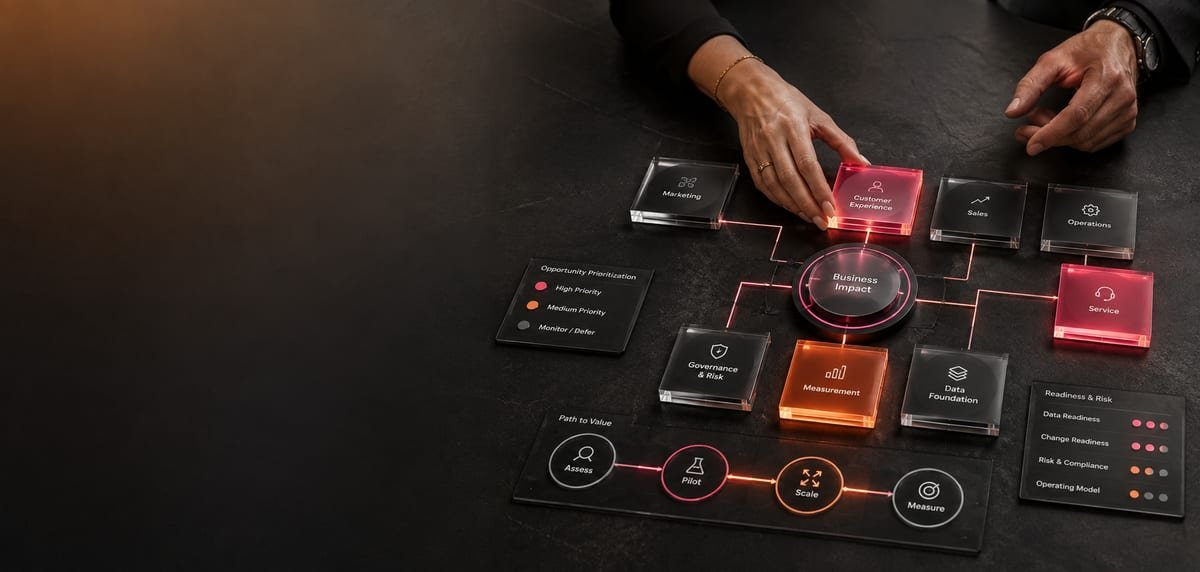
The FAIM AI Strategy Framework
Discover
Business process discovery
Map
AI opportunity mapping
Prioritize
Strategic AI roadmap
Implement
Technology deployment
Optimize
Continuous improvement
Discover

Map

Prioritize

Implement

Optimize
What Clients Gain
Executive Clarity
A practical AI roadmap grounded in your business priorities.
Aligned Teams
Shared understanding across departments about where AI fits.
Smarter Systems
Automation integrated into existing processes to save time and reduce costs.
Competitive Edge
Scalable, human-first AI solutions that evolve with your business.
Human-First AI
Who We Work Best With
- Small to mid-sized B2B companies exploring where AI fits
- Leadership teams that want strategy before tools
- Organizations with repetitive, manual processes ready for smart automation
- Companies that value strong customer experience and human-centered operations
We are probably not the right firm if
- You want a chatbot installed with no strategy behind it
- You want AI to replace your team rather than support it
Questions We Get Before We Start
A vendor sells you their product. We do not resell software and take no commission from any platform, so the recommendation you get is the one we would make if the tool were free. We start by finding where the work actually leaks, and sometimes the answer is that AI is not the fix.
That is the most common place we start. Unused tools usually mean the tool was chosen before the problem was defined. We map how work moves through your team, find where the friction actually sits, then decide what to keep, what to drop, and what is genuinely missing.
The assessment and roadmap typically take a few weeks, depending on how many workflows we map. Implementation runs longer and is phased, so early priorities deliver results while later ones are still being built. We define the timeline before any work starts.
Both. The roadmap is the deliverable, but a roadmap nobody executes is worth nothing. We can implement alongside your team or train your people to run it internally. You are not handed a document and left to it.
No. Most of our clients are B2B and professional services firms with no internal AI or data team. We work with the people who do the work, because they know where the time goes. Where technical capability is genuinely needed, we say so and scope it.